From the Box to the Ocean: What the EU’s New Packaging Regulation Means
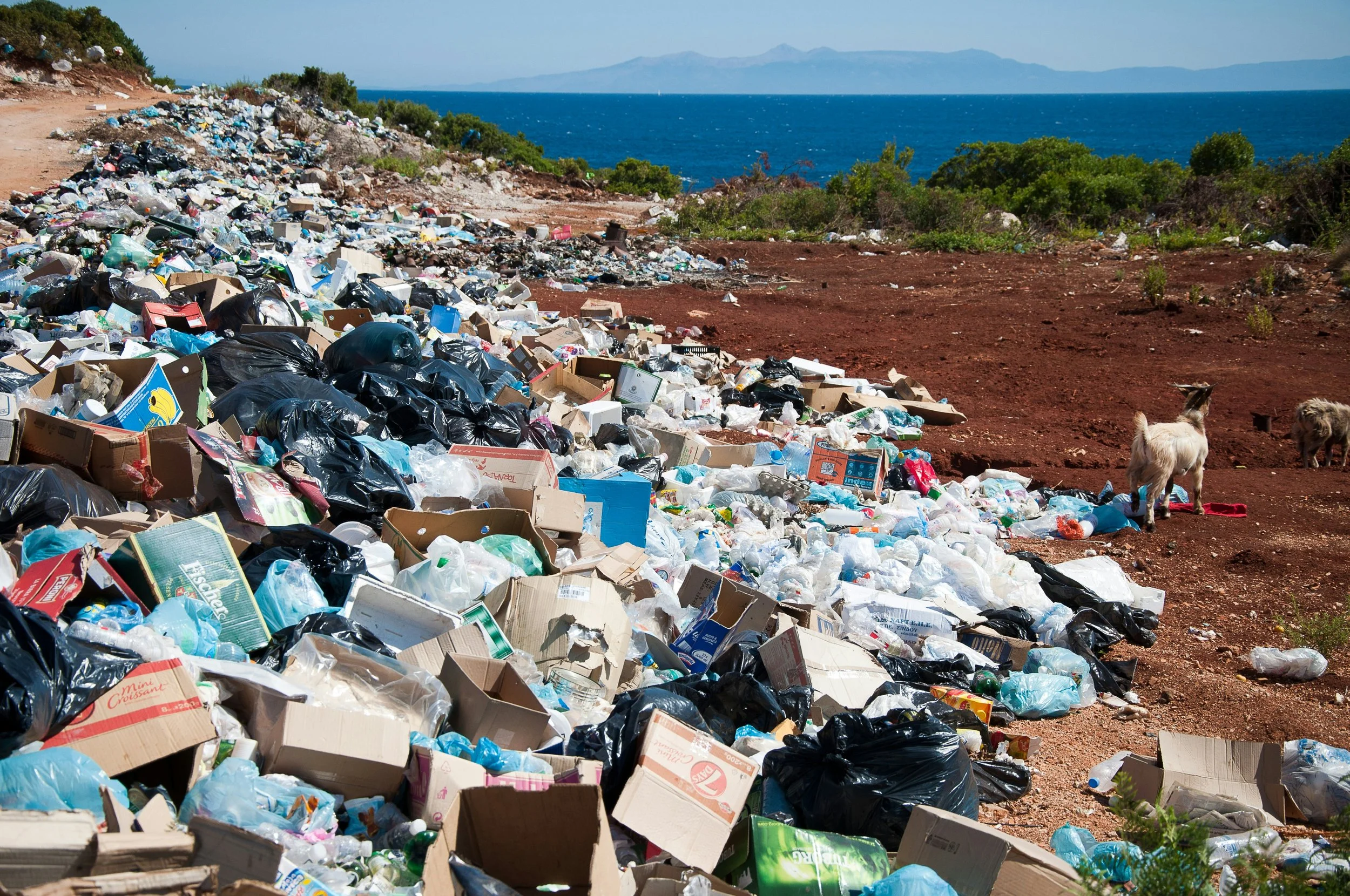
Photo by Antoine GIRET on Unsplash
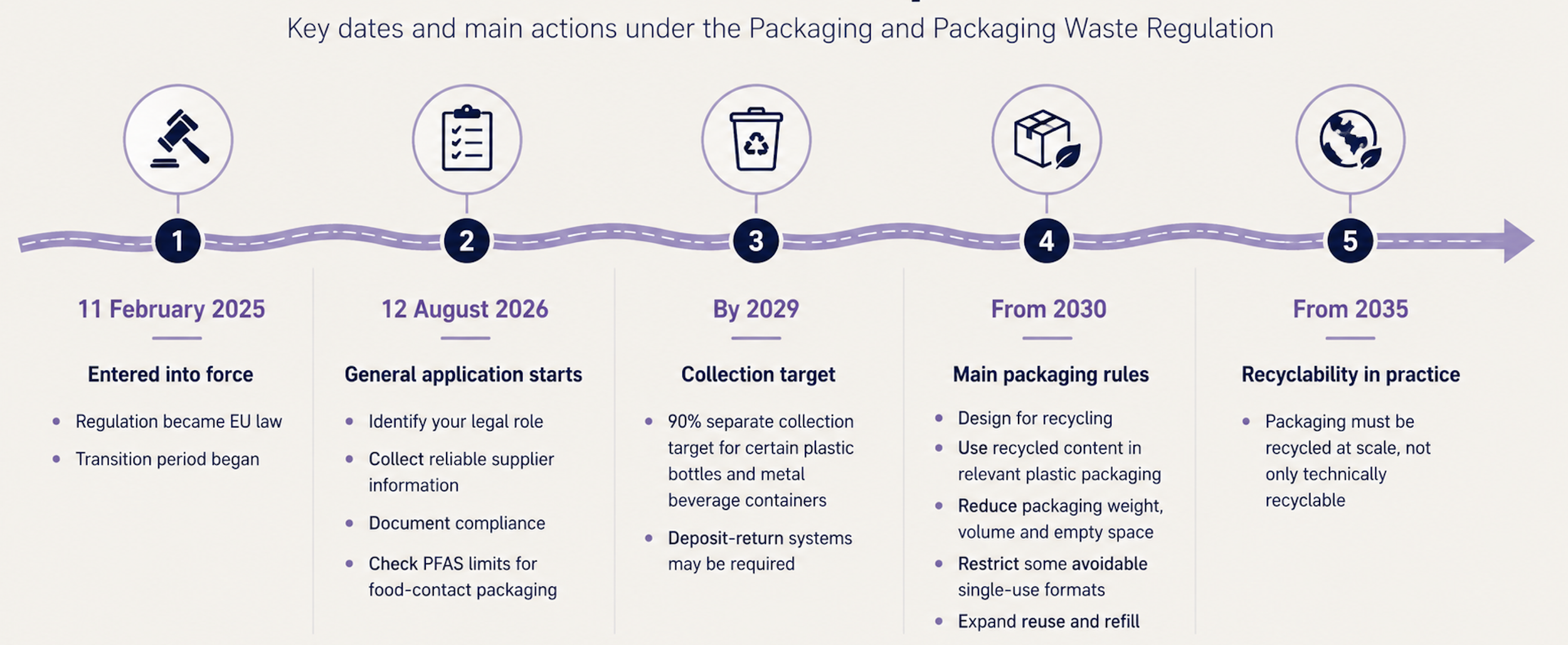
The new EU Packaging and Packaging Waste Regulation, or PPWR, entered into force on 11 February 2025 and will apply from 12 August 2026. It changes how companies design, document and manage packaging, with greater attention to its full life cycle, from material selection to what happens after use.
Think about the last product you ordered online. Maybe the product arrived inside its own box, which was placed inside a much larger delivery box. The remaining space may have been filled with paper, plastic air cushions or bubble wrap. Within minutes of opening the package, several different materials had already become waste.
In 2022, the EU generated approximately 186.5 kilograms of packaging waste per person. Around 40% of the plastics used in the EU are used for packaging, while the European Commission estimates that packaging accounts for approximately half of marine litter.
The PPWR attempts to change this system. Instead of focusing only on what happens after packaging becomes waste, the regulation moves responsibility further upstream. Companies will increasingly need to consider packaging waste before a box, bottle, wrapper or container is designed and placed on the market.
What the PPWR Means for Companies
The PPWR covers all types of packaging placed on the EU market. In simple terms, it asks companies to use less packaging, improve recyclability, include more recycled material, introduce reusable alternatives where suitable, and reduce certain unnecessary single-use formats and harmful substances.
The requirements will not all start at the same time. From 12 August 2026, companies will first need to clarify their legal role, collect reliable packaging information from suppliers and prepare the documentation needed to demonstrate compliance. This includes checking that any food-contact packaging placed on the EU market meets the new PFAS concentration limits. Other requirements, including detailed rules on recyclability, recycled content, packaging reduction and reuse, will be introduced gradually toward 2030 and beyond. Although this gives companies time to prepare, redesigning packaging, working with suppliers and building reliable data processes can take years, so waiting until 2030 would be risky.
One of the biggest changes is that packaging will need to be treated as a compliance topic. Manufacturers will generally need technical documentation and an EU Declaration of Conformity. Companies should first document the rules that already apply and then update their compliance evidence gradually as new requirements come into effect. The documentation must be maintained for five years for single-use packaging and ten years for reusable packaging. Suppliers must also provide manufacturers with the information and documentation required to demonstrate compliance.
Beyond Compliance: Where Packaging Waste Can End Up
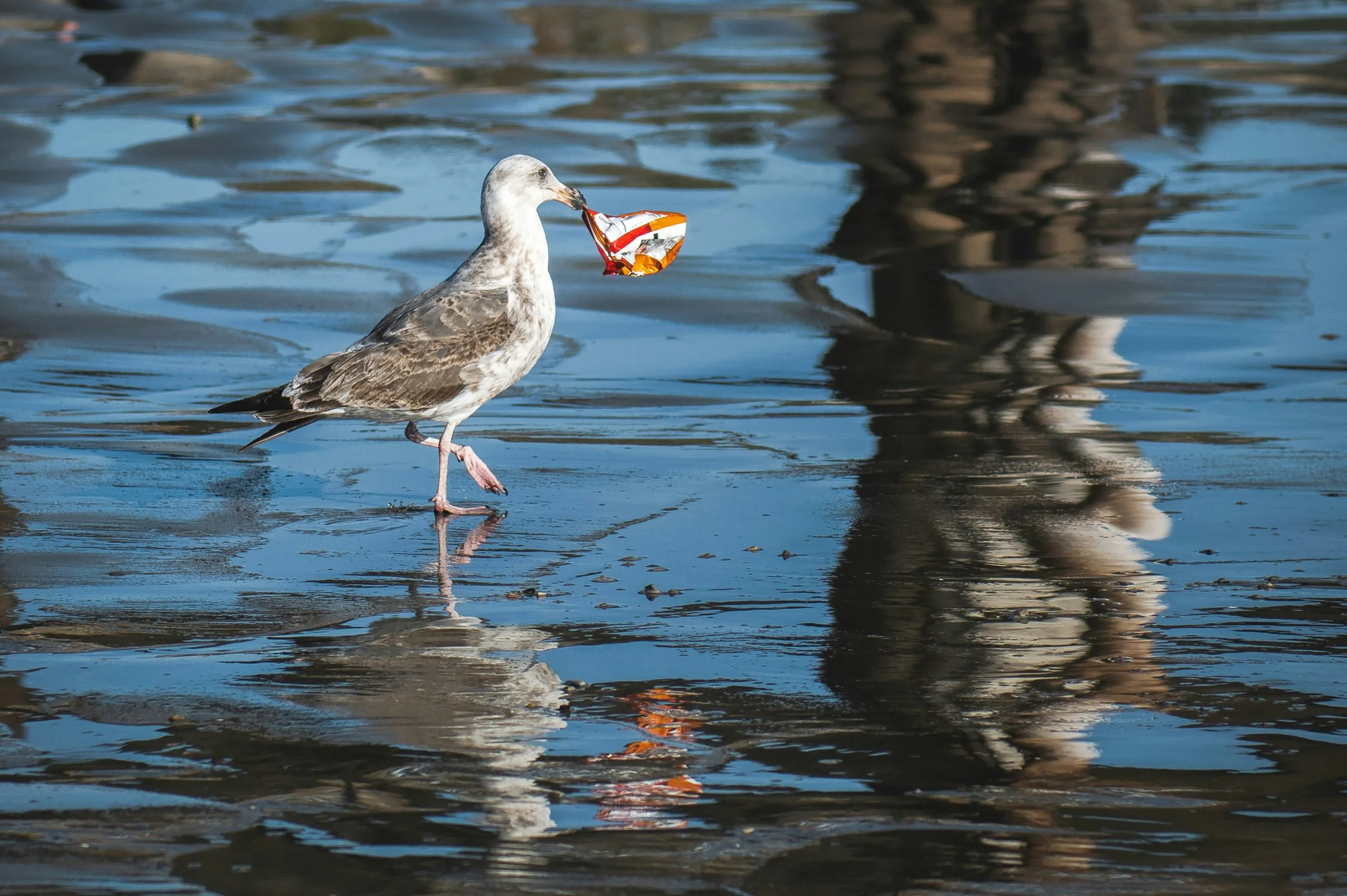
Photo by Tim Mossholder on Unsplash
Behind the documentation, targets and compliance processes, there is a broader environmental purpose. Packaging often has a very short useful life, but its environmental impact can continue long after it has been discarded. A plastic wrapper does not need to be thrown directly into the sea to become marine litter. Marine litter is a helpful example of why better packaging systems matter. Waste that is not properly collected or managed can be carried by wind, rain, drainage systems and rivers. It may travel through cities and across long distances before reaching a beach or marine environment.
In Europe, approximately 80% of marine litter comes from land-based sources, and around 85% of it is plastic. Packaging and small plastic items make up a particularly large share of this waste. Once in the environment, plastic does not simply disappear. Larger items can break into smaller and smaller fragments, eventually becoming microplastics that are extremely difficult to remove. To explore the issue visually, the following maps provide a global view of recorded marine litter and microplastics. LITTERBASE shows where different types of marine litter have been documented, while NOAA’s interactive map presents microplastics observations from marine environments around the world.
The PPWR will not solve ocean pollution by itself. But there are signs that action can produce measurable results. The amount of marine macro-litter recorded along EU coastlines declined by 29% between the 2015–2016 and 2020–2021 monitoring periods. Single-use plastic items declined by approximately 40% during the same period. The amount of waste generated remains high, and plastic pollution continues to affect marine and coastal ecosystems. However, it shows that regulation, improved waste systems, and changes in public behaviour can contribute to visible progress.
This article shares a general overview and some insights from my own learning about the PPWR. It is not legal advice, and companies should assess the requirements that apply to their specific products, packaging formats and role in the supply chain. For more detailed information, see the further reading section below.
Sources / Further reading
Compliance Gate. (n.d.). New EU packaging regulation (PPWR) explained in 15 minutes [Video]. YouTube. Retrieved August 3, 2026, from https://www.youtube.com/watch?v=X9SQUqHHhCk
European Commission. (n.d.). Packaging waste. Directorate-General for Environment. Retrieved August 3, 2026, from https://environment.ec.europa.eu/topics/waste-and-recycling/packaging-waste_en
EUR-Lex. (2025, September 26). Packaging and packaging waste (from 2026). Publications Office of the European Union. https://eur-lex.europa.eu/EN/legal-content/summary/packaging-and-packaging-waste-from-2026.html
European Commission. (2026, March 30). Annex to the Communication to the Commission: Approval of the draft Commission Notice on the guidance document for Regulation (EU) 2025/40 on packaging and packaging waste (C(2026) 2151 final). https://environment.ec.europa.eu/document/download/3d59ca88-539c-4b6b-a623-0f61068e853e_en?filename=Annex+to+the+Communication+to+the+Commission.pdf
European Environment Agency. (2023). From source to sea: The untold story of marine litter. https://www.eea.europa.eu/en/analysis/publications/from-source-to-sea-the-untold-story-of-marine-litter
European Environment Agency. (2025, March 2). EU coastline macro litter trends. https://www.eea.europa.eu/en/european-zero-pollution-dashboards/indicators/eu-coastline-macro-litter-trends
Alfred Wegener Institute, Helmholtz Centre for Polar and Marine Research. (n.d.). LITTERBASE: Distribution of litter types in different realms [Interactive map]. Retrieved August 3, 2026, from https://litterbase.awi.de/litter
National Centers for Environmental Information. (n.d.). Marine microplastics. National Oceanic and Atmospheric Administration. Retrieved August 3, 2026, from https://www.ncei.noaa.gov/products/microplastics
Regulation (EU) 2025/40 of the European Parliament and of the Council of 19 December 2024 on packaging and packaging waste, amending Regulation (EU) 2019/1020 and Directive (EU) 2019/904, and repealing Directive 94/62/EC. (2025). Official Journal of the European Union, L 2025/40. https://eur-lex.europa.eu/legal-content/EN/TXT/PDF/?uri=OJ:L_202500040
Surfers Against Sewage. (n.d.). Plastic pollution: Facts & figures. Retrieved August 3, 2026, from https://www.sas.org.uk/plastic-pollution/plastic-pollution-facts-figures/
United States Environmental Protection Agency. (2025, October 31). About plastic products and plastic pollution. https://www.epa.gov/plastics/about-plastic-products-and-plastic-pollution
Ritchie, H. (2023, October 5). How much plastic waste ends up in the ocean? Our World in Data. https://ourworldindata.org/how-much-plastic-waste-ends-up-in-the-ocean
European Commission. (2026, June 10). Guidance document for Regulation (EU) 2025/40 on packaging and packaging waste (Commission Notice C/2026/3084). Official Journal of the European Union. https://eur-lex.europa.eu/legal-content/EN/TXT/PDF/?uri=OJ%3AC_202603084
MSFD TECHNICAL GROUP ON MARINE LITTER, .., HANKE, G., WALVOORT, D., RUIZ-OREJÓN, L.F., VAN LOON, W.M.G.M., GIORGETTI, A., MOLINA-JACK, M.E. and VINCI, M., European Coastline Macro Litter Trends 2015 - 2021, Publications Office of the European Union, Luxembourg, 2024, https://data.europa.eu/doi/10.2760/0752301, JRC138907.
